
Every screen, built for
the counter it sits on
The whole shop in one system: billing, stock, purchases, customers, cash and reports. Below is what each part does, in the order you would meet it on your first day.
A till that keeps up with the queue
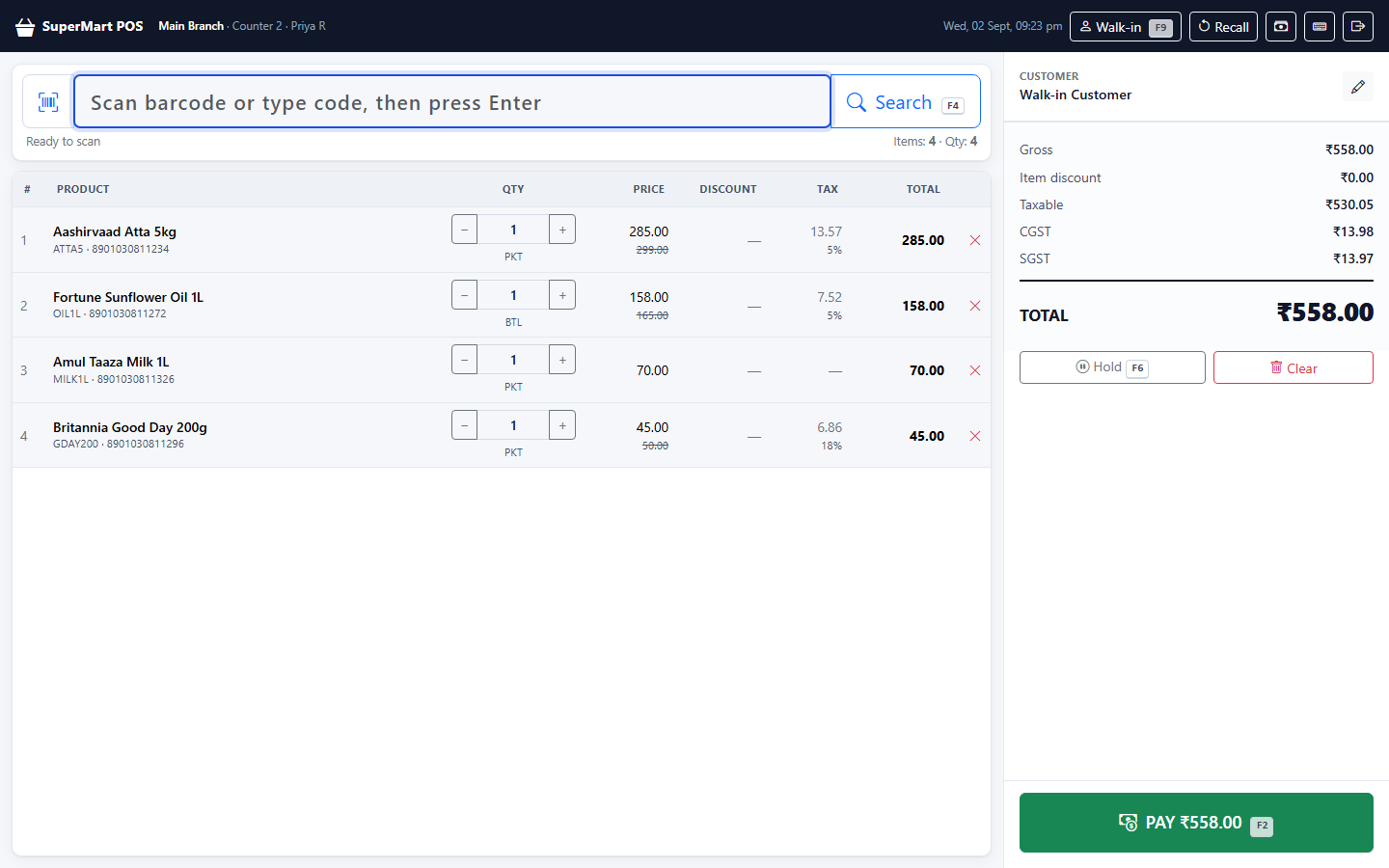
The billing screen is keyboard-first, because a mouse is slower than a cashier. Scan, total, tender, print — and the hand never leaves the scanner.
- Barcode, name or code search, with the till holding focus throughout
- Weighing-scale labels decoded into the right weight and price
- Split payment across cash, card, UPI and credit on one bill
- Hold a bill, serve the next customer, bring it back
- Returns and exchanges against the original bill, with stock put back
- Thermal receipt or A4 tax invoice, printed or re-printed later
One number, and a reason behind it
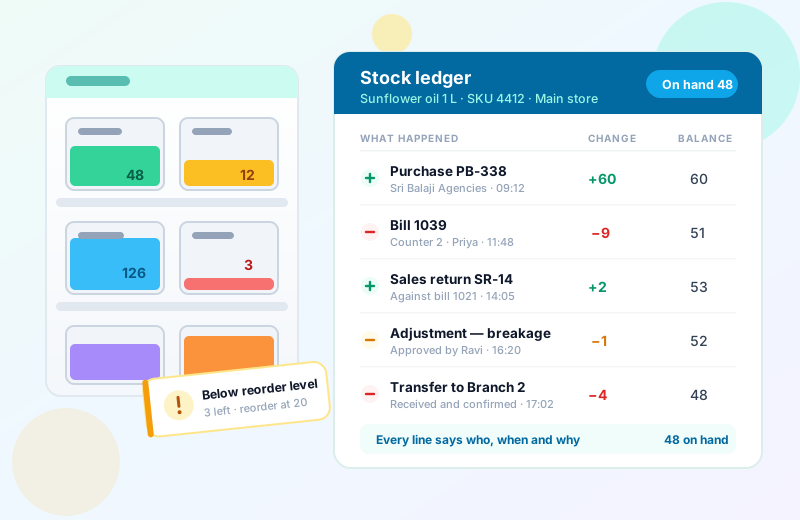
Stock is not a figure somebody types in. It is the sum of everything that has happened to an item, and every one of those movements is on the record.
- Sales, purchases, returns, adjustments and transfers all move stock live
- A ledger line per movement: what, how much, who, when and why
- Reorder levels, with low-stock and out-of-stock lists worth reading
- Batches with cost and expiry, sold oldest-first
- Separate stock per branch, and transfers that must be received
- Stocktake adjustments that record the difference rather than hide it
Purchases, suppliers, customers and cash
Everything that happens away from the till, and still decides what you earn.
Purchase entry
Enter what arrived, at what it cost. Stock goes up, cost price updates, and the margin report starts telling the truth.
Suppliers and dues
Who you buy from, what is outstanding, and what you paid against which bill.
Purchase returns
Send damaged goods back with a document, and take the stock out where it went.
Customer accounts
Names, numbers, history and credit. What each customer buys, and what they owe you.
Shifts and the drawer
Open with a float, close with a count. The difference is recorded per cashier, per shift.
Labels and barcodes
Print your own labels for loose or unbarcoded goods, in the sheet size you already buy.
Loyalty points
Points earned and redeemed against a customer account, with a ledger behind every balance.
More than one shop
One catalogue, separate stock per branch, and staff who only see their own store.
API access
Read your own data out, or push products in, from whatever else you run.
Numbers that answer a question
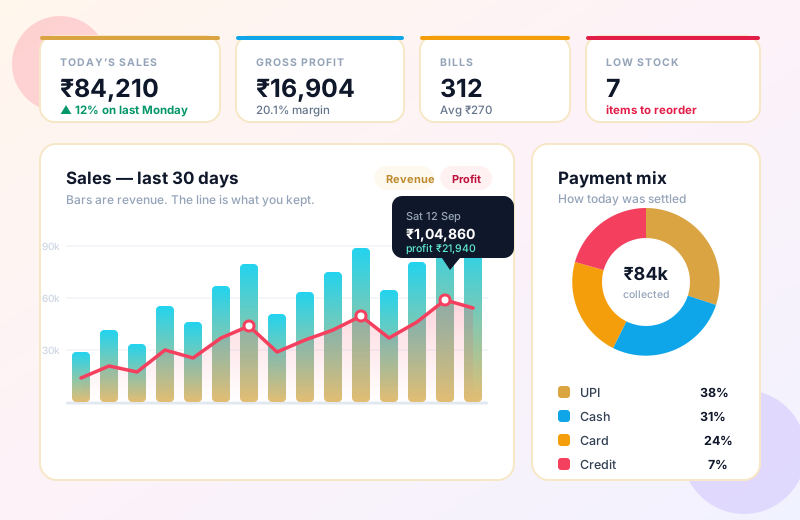
Not forty exports nobody opens. A handful of reports, each written to answer something a shopkeeper actually asks on a Monday morning.
- Sales — by day, counter, cashier, product or category
- Profit — what it sold for, what it cost, what you kept
- Tax — rate-wise taxable value and tax, ready for the return
- Inventory — valuation, slow movers and what to reorder
- Payments — the mix of cash, card, UPI and credit
- Every one of them exports to CSV, which every spreadsheet opens
Who may do what, decided once
A shop is not one person. Roles decide what each of them can reach, and the server enforces it whether the request came from a screen or not.
Roles per person
Cashier, manager, stock keeper, accounts — each sees the screens they need and no more.
Discount ceilings
A maximum discount per role. A till cannot give away more than you allowed.
An audit trail
Who changed a price, who cancelled a bill, who adjusted stock — with the time it happened.
Server-side truth
Prices, taxes and stock checks are settled on the server. A tampered screen changes nothing.
Password rules
Lockout on repeated failures, forced change on first sign-in, and sessions that expire.
Your data, exportable
Catalogue, customers, suppliers, ledger and sales history — CSV, whenever you want it.
Want to see it on your counter?
Plans start at ₹1,999.00 a month, and you can change size whenever you like.